
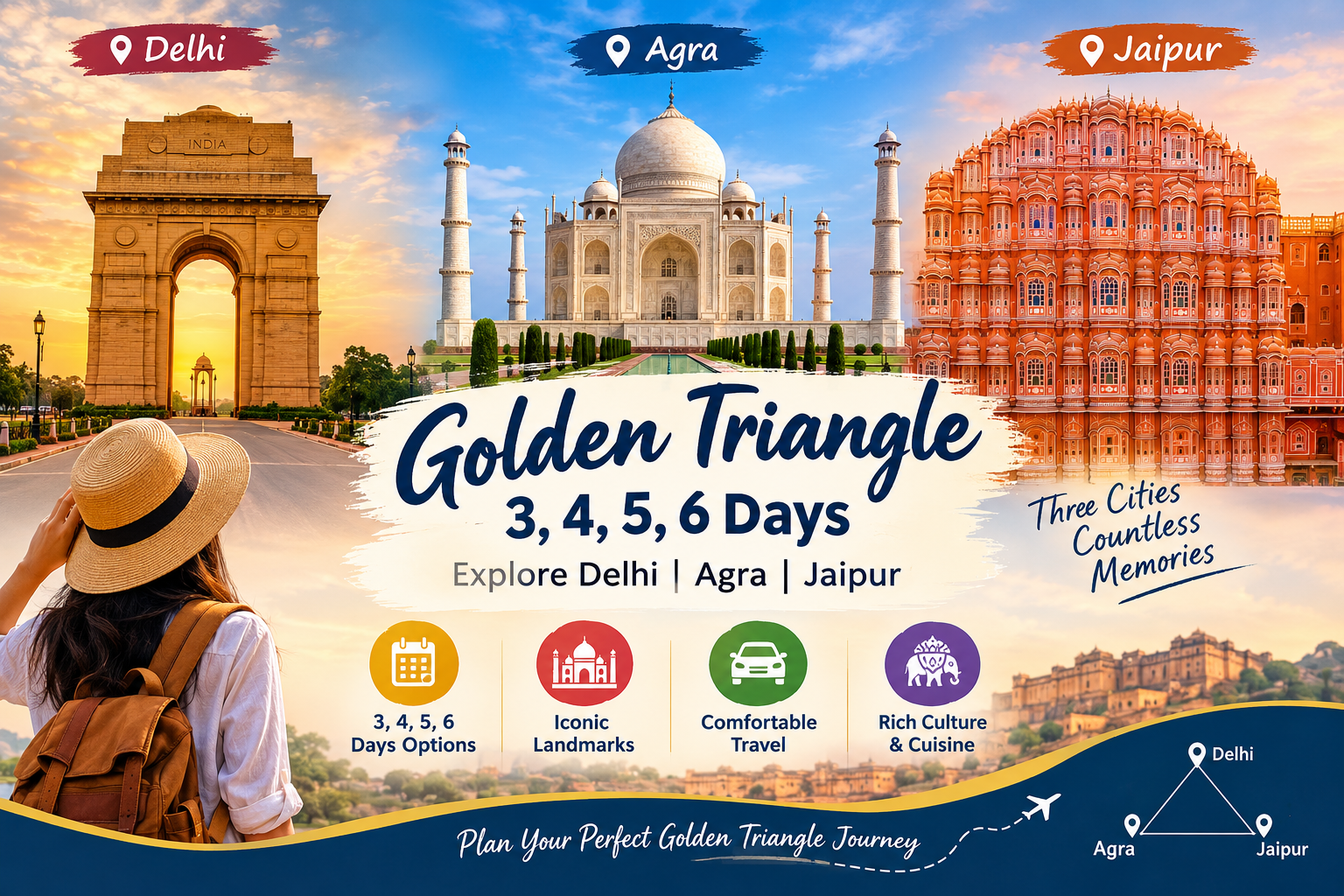
Planning a trip through Delhi, Agra, and Jaipur sounds straightforward until you start deciding how many days to spend in each city. The Golden Triangle 3, 4, 5, 6 days itinerary can be designed in several ways, depending on your travel pace, sightseeing priorities, budget, and interest in food, history, shopping, culture, and local experiences.

The classic Golden Triangle connects Delhi, Agra, and Jaipur, three destinations that together introduce travelers to Mughal architecture, Rajput heritage, bustling markets, historic neighborhoods, grand monuments, and some of North India's most memorable food. While a three-day trip is possible for travelers with limited time, adding a fourth, fifth, or sixth day creates considerably more breathing room.
This guide explains what you can realistically do in 3, 4, 5, or 6 days, how to divide your time, which attractions deserve priority, how to travel between the cities, when to visit, and how to avoid the common mistakes that can turn a rewarding itinerary into a tiring sightseeing marathon.
If you are comparing different trip lengths before booking, this detailed guide to Golden Triangle tours from Delhi can also help you understand how the route works and what type of itinerary may suit your travel style.
What Is the Golden Triangle?
The Golden Triangle is one of India's most popular travel circuits, linking:
-
Delhi – India's capital and a blend of historic and modern India
-
Agra – home of the Taj Mahal and major Mughal monuments
-
Jaipur – the capital of Rajasthan, known for forts, palaces, markets, and Rajput heritage
The three cities form a roughly triangular route on the map, although the actual road journey is not a perfect geometric triangle.
The circuit is particularly convenient for first-time visitors because each destination offers a noticeably different experience.
Delhi introduces you to India's political history, Mughal-era landmarks, religious architecture, street food, and contemporary urban life. Agra focuses heavily on Mughal history and monumental architecture, while Jaipur brings Rajasthan's royal heritage, colorful bazaars, traditional crafts, and imposing hill forts.
The route can be traveled by private car, train, or a combination of both.
How Many Days Do You Need for the Golden Triangle?
There is no single correct duration.
Your choice depends largely on what you want from the trip.
| Duration | Travel Style | What It Allows |
|---|---|---|
| 3 Days | Fast-paced | Main highlights of Delhi, Agra, and Jaipur |
| 4 Days | Compact but comfortable | Major sights with slightly more breathing room |
| 5 Days | Balanced | Better sightseeing pace and additional experiences |
| 6 Days | Relaxed and immersive | Major attractions plus markets, culture, and optional experiences |
A useful rule is simple:
Three days are enough to see the highlights. Four days make the route easier. Five days create a balanced holiday. Six days allow you to slow down and explore beyond the standard checklist.
Golden Triangle 3 Days: The Fast-Paced Classic Route
A Golden Triangle 3 days itinerary works well for travelers who have limited vacation time and want to experience India's most famous landmarks.
However, it is important to set realistic expectations. You will spend a meaningful amount of time traveling, so this is not the ideal choice if you prefer slow mornings, long lunches, extensive shopping, or spontaneous exploration.
Suggested 3-Day Route
Day 1: Delhi → Agra
Begin early in Delhi and travel toward Agra.
Depending on your departure point and traffic, the road journey can take several hours. Once in Agra, concentrate on its most important sights.
Possible sightseeing:
-
Taj Mahal
-
Agra Fort
-
Mehtab Bagh
-
Local marble and handicraft areas
If you want to visit the Taj Mahal at sunrise, your schedule should be planned around its opening hours and the day's conditions.
Spend the night in Agra if possible.
Day 2: Agra → Jaipur
Start with any Agra sightseeing you could not complete on Day 1.
Then continue toward Jaipur.
The journey gives you an opportunity to see the changing landscape of northern India. Depending on your interests and available time, you may stop at Fatehpur Sikri, the historic Mughal-era city located near Agra.
After reaching Jaipur, explore a nearby market or enjoy a relaxed evening.
Overnight in Jaipur.
Day 3: Jaipur → Delhi
Use the morning for Jaipur's principal attractions.
Depending on opening times and your departure schedule, you could visit:
-
Amber Fort
-
City Palace
-
Hawa Mahal
-
Jantar Mantar
-
Jal Mahal viewpoint
-
Jaipur markets
Return to Delhi later in the day.
Who Should Choose Three Days?
This version suits:
-
Travelers with limited leave
-
First-time visitors wanting the major landmarks
-
Business travelers extending their stay
-
Travelers who prefer sightseeing over relaxation
-
People combining the Golden Triangle with another Indian destination
It is less suitable for travelers who dislike early starts or long travel days.
Golden Triangle 4 Days: A More Comfortable Introduction
Adding one day changes the character of the journey considerably.
A Golden Triangle 4 days itinerary still moves efficiently, but you can distribute sightseeing more sensibly.
One practical structure is:
Day 1 – Delhi
Spend the first full day exploring Delhi rather than treating the capital as merely the starting point.
Depending on your interests, consider:
-
India Gate area
-
Humayun's Tomb
-
Qutub Minar
-
Lotus Temple
-
Red Fort
-
Jama Masjid area
-
Chandni Chowk
-
Raj Ghat
You do not need to visit every attraction.
Choose a combination that reflects your interests.
For example, history lovers may prioritize Qutub Minar, Humayun's Tomb, Red Fort, and Old Delhi. Travelers interested in architecture may prefer a mix of Mughal, Indo-Islamic, and modern landmarks.
Day 2 – Delhi to Agra
Leave Delhi in the morning and continue toward Agra.
Spend the afternoon visiting Agra Fort and other nearby attractions.
If you have sufficient time, visit Mehtab Bagh for views toward the Taj Mahal from across the Yamuna River.
Stay overnight in Agra.
Day 3 – Taj Mahal and Jaipur
Visit the Taj Mahal early in the morning.
The early hours can be particularly rewarding because the monument's appearance changes with the light, while temperatures may be more manageable during warmer periods.
After breakfast, begin the journey toward Jaipur.
A stop at Fatehpur Sikri can be included if opening hours, traffic, and energy levels allow.
Arrive in Jaipur and spend the evening exploring a market or enjoying a traditional meal.
Day 4 – Jaipur
Dedicate the day to Jaipur.
A practical sightseeing sequence could include:
Morning: Amber Fort
Late morning: Jal Mahal viewpoint
Afternoon: City Palace and Jantar Mantar
Late afternoon: Hawa Mahal and surrounding markets
This arrangement gives you enough time to appreciate Jaipur without constantly watching the clock.
Golden Triangle 5 Days: The Balanced Choice
For many travelers, Golden Triangle 5 days offers a particularly useful balance between sightseeing and relaxation.
Instead of trying to compress every attraction into a short visit, you can spend meaningful time in each destination.
Day 1 – Delhi Arrival and Easy Exploration
If arriving in Delhi from another country or city, avoid scheduling an exhausting sightseeing program immediately.
Check into your hotel, rest, and explore something nearby.
If your arrival is early, visit one or two attractions such as:
-
Humayun's Tomb
-
India Gate
-
Lodhi Garden
-
Connaught Place
Keep the first day flexible.
Day 2 – Delhi Heritage and Old Delhi
Spend the second day on Delhi's historical side.
A possible route:
-
Red Fort
-
Jama Masjid
-
Chandni Chowk
-
Raj Ghat
-
Qutub Minar or Humayun's Tomb
Old Delhi deserves more than a quick drive-through.
Walking through its narrow streets, observing traditional shops, tasting local snacks, and seeing how historic neighborhoods coexist with modern Delhi can be as memorable as visiting a monument.
Day 3 – Delhi to Agra
Travel to Agra.
Visit:
-
Agra Fort
-
Taj Mahal
-
Mehtab Bagh
If you are visiting the Taj Mahal around sunrise, arrange transportation and tickets in advance where appropriate.
Stay overnight in Agra.
Day 4 – Agra to Jaipur
Travel toward Jaipur after breakfast.
Consider stopping at Fatehpur Sikri if you are interested in Mughal architecture and history.
On arrival in Jaipur, spend the evening around one of the city's historic markets.
This is a good opportunity to shop for:
-
Block-printed textiles
-
Handicrafts
-
Jewelry
-
Traditional décor
-
Rajasthani souvenirs
Shop carefully and compare prices before purchasing.
Day 5 – Jaipur Heritage Day
Use the final day for Jaipur's major attractions.
A possible itinerary:
Morning: Amber Fort
Late morning: Jal Mahal
Afternoon: City Palace
Afternoon: Jantar Mantar
Evening: Hawa Mahal area and local markets
If you have a late departure, you can enjoy a longer lunch or shopping session rather than adding another monument.
Golden Triangle 6 Days: A Relaxed and Deeper Experience
A Golden Triangle 6 days itinerary is ideal if you want more than a collection of famous photographs.
Six days give you enough flexibility to experience the cities at a more comfortable pace.
Day 1 – Delhi Arrival
Arrive, settle into your hotel, and keep sightseeing light.
Depending on arrival time, explore Connaught Place, India Gate, or a nearby neighborhood.
Day 2 – Old and Historic Delhi
Dedicate the second day to Delhi's heritage.
Possible attractions include:
-
Red Fort
-
Jama Masjid
-
Chandni Chowk
-
Raj Ghat
-
Humayun's Tomb
-
Qutub Minar
Rather than rushing between distant monuments, organize the day geographically.
This saves time in Delhi's unpredictable traffic.
Day 3 – Delhi to Agra
Leave Delhi after breakfast.
Visit Agra Fort after arrival and explore the surrounding area.
You can use the evening for a relaxed dinner or a Taj Mahal viewpoint.
Day 4 – Taj Mahal and Agra Experiences
Start early with the Taj Mahal.
Afterward, take a slower approach to Agra.
Depending on your interests, consider:
-
Itmad-ud-Daulah
-
Mehtab Bagh
-
Local crafts
-
Mughal architecture
-
Traditional cuisine
You can then travel to Jaipur later in the day or remain in Agra depending on your preferred pace and transport arrangements.
Day 5 – Jaipur Forts and Palaces
Spend a full day exploring Jaipur.
Start with Amber Fort when possible, then continue to:
-
Jal Mahal
-
City Palace
-
Jantar Mantar
-
Hawa Mahal
Leave time for lunch and breaks.
Jaipur becomes much more enjoyable when you are not trying to photograph every monument within a few hours.
Day 6 – Jaipur Culture, Food, and Markets
Use your final day differently.
Explore Jaipur's markets, local crafts, architecture, and food.
You could also consider an experience such as:
-
Traditional cooking
-
Block printing demonstration
-
Local handicraft workshop
-
Heritage neighborhood walk
-
Rajasthani cultural performance
This final day gives the trip a sense of place rather than ending with another checklist of monuments.
Delhi: What Makes the Capital Worth Exploring?
Many short Golden Triangle itineraries reduce Delhi to a hotel, airport, and transfer point.
That is a missed opportunity.
Delhi has layers of history dating across several periods, and the city combines old neighborhoods with modern business districts.
Qutub Minar
The Qutub complex is one of Delhi's most recognizable historical sites.
Its architecture reflects the early Indo-Islamic period, and the surrounding monuments make the visit more than simply photographing the tower.
Humayun's Tomb
This grand Mughal garden tomb is particularly interesting for travelers who want to understand the architectural development that eventually influenced later Mughal monuments.
Red Fort
The Red Fort represents an important chapter of Mughal Delhi.
Its scale makes more sense when you understand its role as a royal complex rather than viewing it simply as another red sandstone building.
Old Delhi
Old Delhi provides a completely different experience.
Expect crowds, narrow streets, food stalls, historic buildings, and a fast-moving atmosphere.
Wear comfortable footwear and keep valuables secure in crowded areas.
Agra: Beyond the Taj Mahal
The Taj Mahal is obviously the centerpiece of Agra, but the city deserves more attention than a quick photo stop.
Taj Mahal
Plan your visit around official opening arrangements and the time of day.
Sunrise visits can offer softer light and a different atmosphere from midday.
Remember that entry regulations, ticket arrangements, security requirements, and visiting hours can change, so check current official information before your trip.
Agra Fort
Agra Fort provides important context for understanding Mughal history.
Its courtyards, palaces, gates, and views toward the Taj Mahal make it one of the essential stops in the city.
Itmad-ud-Daulah
Often called the "Baby Taj," this monument is smaller than the Taj Mahal but architecturally significant.
It can be worthwhile for travelers interested in Mughal decorative techniques and intricate stonework.
Mehtab Bagh
For a different perspective of the Taj Mahal, Mehtab Bagh sits across the Yamuna River.
It can be particularly pleasant around sunset, although conditions vary by season and weather.
Jaipur: Where Rajasthan's Royal Heritage Takes Center Stage
Jaipur has a distinct personality compared with Delhi and Agra.
The city combines royal architecture, colorful markets, traditional crafts, and modern hospitality.
Amber Fort
Amber Fort is one of Jaipur's major attractions.
Set against the hills outside the central city, it combines defensive architecture with elaborate royal spaces.
Allow enough time for the visit rather than treating it as a quick photo stop.
City Palace
The City Palace complex offers insight into Jaipur's royal history.
Its courtyards, decorative elements, galleries, and museum collections make it a useful stop for understanding the city's heritage.
Hawa Mahal
The Palace of Winds is one of Jaipur's most recognizable structures.
The façade is particularly photogenic from the street opposite the monument.
You do not necessarily need to spend a long time inside to appreciate the exterior architecture.
Jantar Mantar
This historic astronomical observatory is especially interesting for travelers who enjoy science, mathematics, architecture, or unusual historical attractions.
How to Travel Between Delhi, Agra, and Jaipur
Transportation can significantly influence your Golden Triangle experience.
Private Car
A private vehicle with a driver provides the greatest flexibility.
Advantages include:
-
Door-to-door transportation
-
Flexible departure times
-
Easy luggage handling
-
Ability to stop along the route
-
Convenient sightseeing between cities
The disadvantage is that road travel can be affected by traffic, especially around Delhi and Jaipur.
Train
Trains can be an efficient alternative, particularly between Delhi and Agra.
However, you need to coordinate station transfers, departure times, luggage, and local transportation.
For travelers comfortable with rail travel, trains can save time on some sections of the route.
Flight
Flying between these cities generally does not make much sense for a classic Golden Triangle itinerary because of airport transfers and the relatively short geographic distances involved.
For most travelers, road or rail transportation is more practical.
Which Golden Triangle Duration Should You Choose?
Instead of asking which duration is universally "best," consider what type of traveler you are.
Choose 3 Days If You:
-
Have very limited time
-
Want only the major landmarks
-
Are comfortable with early starts
-
Do not mind a busy schedule
Choose 4 Days If You:
-
Want the highlights with a little more flexibility
-
Prefer not to rush every attraction
-
Have limited vacation days
Choose 5 Days If You:
-
Want a balanced experience
-
Enjoy history and culture
-
Want time for markets and food
-
Prefer moderate travel days
Choose 6 Days If You:
-
Prefer a slower pace
-
Enjoy local experiences
-
Want additional time in Delhi, Agra, or Jaipur
-
Want flexibility for unexpected delays
-
Are interested in photography, shopping, food, and culture
Best Time for a Golden Triangle Trip
The Golden Triangle can be visited throughout the year, but weather can strongly affect comfort.
October to March
These months are generally popular for sightseeing because temperatures are more comfortable than during the hottest part of the year.
Winter mornings can be cool, particularly in Delhi and Agra.
Fog can occasionally affect visibility and transportation, especially during winter.
April to June
Temperatures can become extremely high.
If traveling during this period:
-
Start sightseeing early
-
Carry water
-
Wear breathable clothing
-
Use sun protection
-
Plan indoor breaks
July to September
The monsoon season can bring rain and humidity.
Rain may occasionally disrupt road travel, but it can also bring greener landscapes and fewer visitors at some attractions.
Always keep some flexibility in your schedule during periods of heavy rain.
What to Pack for the Golden Triangle
You do not need an enormous suitcase.
Useful items include:
-
Comfortable walking shoes
-
Lightweight clothing
-
A light jacket for winter
-
Sun protection
-
Sunglasses
-
Reusable water bottle
-
Portable charger
-
Small day bag
-
Basic personal medication
-
Copies of important travel documents
Modest clothing is useful when visiting religious sites.
A lightweight scarf can also be convenient for sun protection and for covering shoulders when appropriate.
Food You Should Try
Food is an important part of the Golden Triangle experience.
Delhi
Consider trying:
-
Chole bhature
-
Parathas
-
Kebabs
-
Butter chicken
-
Chaat
Agra
Look for:
-
Petha
-
Mughlai dishes
-
Bedai
-
Local snacks
Jaipur
Try:
-
Dal baati churma
-
Ghevar
-
Kachori
-
Rajasthani thali
-
Gatte ki sabzi
When eating street food, choose busy stalls with high customer turnover and good visible hygiene practices.
Travelers with sensitive stomachs should be particularly cautious with raw foods, untreated water, and unfamiliar dairy products.
Shopping Along the Golden Triangle
Each city has a different shopping personality.
Delhi
Good for:
-
Handicrafts
-
Books
-
Textiles
-
Contemporary Indian products
-
Traditional clothing
Agra
Known for:
-
Marble inlay work
-
Leather goods
-
Handicrafts
-
Souvenirs
Jaipur
Particularly associated with:
-
Block-printed textiles
-
Jewelry
-
Blue pottery
-
Handicrafts
-
Traditional clothing
Do not feel pressured to purchase something immediately.
Compare prices, inspect quality, and understand what you are buying.
Common Mistakes to Avoid
Even a well-designed itinerary can become frustrating if you overlook simple details.
Trying to See Everything
The Golden Triangle contains far more attractions than you can realistically visit in a few days.
Choose priorities.
Starting Too Late
Delhi, Agra, and Jaipur can become busy, and outdoor sightseeing is more comfortable during cooler parts of the day.
Ignoring Travel Time
A map may make the route look simple, but actual journey times vary because of traffic, road conditions, weather, and city congestion.
Leave buffer time.
Overloading the Itinerary
Four major monuments in one afternoon may look impressive on paper but can become exhausting in practice.
Quality matters more than quantity.
Forgetting Local Opening Rules
Monuments may have weekly closing days, seasonal hours, security restrictions, or ticketing procedures.
Verify current information before your visit.
Booking Only for Location
A hotel close to one attraction may be inconvenient for the rest of your itinerary.
Consider access to transport, restaurants, safety, cleanliness, and your overall route.
How to Make the Golden Triangle More Meaningful
The most memorable trips are often not the ones with the longest attraction list.
Try adding one or two experiences that allow you to interact with the destination.
For example:
-
Take a guided heritage walk in Old Delhi.
-
Learn about Mughal architecture at Agra Fort.
-
Watch a traditional craft demonstration.
-
Explore Jaipur's textile traditions.
-
Take a cooking class.
-
Eat a regional meal rather than relying entirely on international restaurants.
-
Spend time photographing everyday street life.
-
Visit a local market without a fixed shopping list.
These activities help connect the famous monuments with the living culture around them.
A Practical Golden Triangle Planning Checklist
Before leaving home, make sure you have considered:
Before Booking
-
Decide between 3, 4, 5, and 6 days.
-
Choose your preferred transportation.
-
Check the season and expected weather.
-
Decide whether you want a private vehicle or public transportation.
-
Select hotels based on the complete route rather than one attraction.
Before Each Sightseeing Day
-
Check opening hours.
-
Confirm ticket requirements.
-
Look at the weather.
-
Carry sufficient water.
-
Wear suitable footwear.
-
Keep some buffer time.
During the Trip
-
Keep your passport and valuables secure.
-
Use reputable transportation.
-
Be careful with unofficial guides.
-
Confirm prices before accepting services.
-
Stay hydrated.
-
Respect photography restrictions.
-
Follow monument and religious-site rules.
Can You Add More Destinations to the Golden Triangle?
Yes, but additional destinations should be added according to the number of days available.
With three days, adding another major city usually makes the itinerary unnecessarily rushed.
With five or six days, you have more flexibility.
Possible extensions include:
-
Varanasi for spirituality and Ganges culture
-
Ranthambore for wildlife
-
Pushkar for pilgrimage and cultural experiences
-
Udaipur for lakes and Mewar heritage
-
Jodhpur for forts and blue-city scenery
However, these additions change the nature of the trip and require additional transportation.
If the Golden Triangle is your first experience of India, it can be worthwhile to experience Delhi, Agra, and Jaipur properly before adding multiple destinations.
Is the Golden Triangle Suitable for First-Time Visitors to India?
Yes, the route is frequently chosen by first-time international visitors because it offers a concentrated introduction to several important aspects of India.
Within a relatively short journey, travelers encounter:
-
Mughal history
-
Rajput heritage
-
UNESCO-associated monuments
-
Indian cuisine
-
Traditional crafts
-
Religious architecture
-
Major urban centers
-
Historic markets
-
Modern Indian hospitality
At the same time, visitors should understand that Delhi, Agra, and Jaipur can be busy, noisy, crowded, and visually intense.
That is part of the experience, but planning makes the journey considerably easier.
Golden Triangle 3, 4, 5, 6 Days: Quick Comparison
| Feature | 3 Days | 4 Days | 5 Days | 6 Days |
|---|---|---|---|---|
| Delhi | Highlights | Major sights | Deeper exploration | More flexible |
| Agra | Taj Mahal + Fort | Main attractions | More experiences | Relaxed sightseeing |
| Jaipur | Highlights | Full day | Full day + markets | Heritage + experiences |
| Pace | Fast | Moderate-fast | Balanced | Relaxed |
| Shopping | Limited | Some | Good | Plenty of time |
| Local experiences | Limited | Some | Possible | Easy to include |
| Flexibility | Low | Moderate | Good | High |
| Ideal for | Short trips | Compact holidays | Balanced holidays | Slow travelers |
Frequently Asked Questions
Is 3 days enough for the Golden Triangle?
Three days can cover the principal highlights of Delhi, Agra, and Jaipur, but the itinerary will be relatively fast-paced. It works best when your priority is seeing the major monuments rather than having a relaxed holiday.
Is 4 days better for a Golden Triangle itinerary?
Four days provide more flexibility than three days and make it easier to allocate meaningful sightseeing time to Delhi, Agra, and Jaipur.
How many days are ideal for a Golden Triangle trip?
Five or six days allow more time for sightseeing, meals, markets, cultural experiences, and rest. Travelers with limited time can still complete the circuit in three or four days.
Can I do the Golden Triangle in 5 days?
Yes. Five days are sufficient for a well-paced Delhi, Agra, and Jaipur itinerary with time for major monuments and additional cultural experiences.
